

Introduction
Every crop changes continuously. Growth develops. Environmental conditions evolve. Water availability changes. Field activities influence crop development.
And each of these changes generates information! For agricultural organizations, the challenge is understanding these changes early enough to make better operational decisions. This is the purpose of Crop Monitoring
Crop monitoring creates a continuous understanding of crop and field conditions by combining observations, environmental information and operational data. The objective is not simply to observe crops.
It is to understand how conditions evolve and how that information can support agricultural operations.
What is crop monitoring?
Crop Monitoring is the systematic observation of crops and the conditions that influence their development throughout the production cycle. Traditionally, monitoring has relied heavily on direct field inspections and the experience of farmers and agronomists. These activities remain essential.
Digital monitoring technologies, however, can complement field expertise by collecting information continuously and creating historical records of changing conditions.
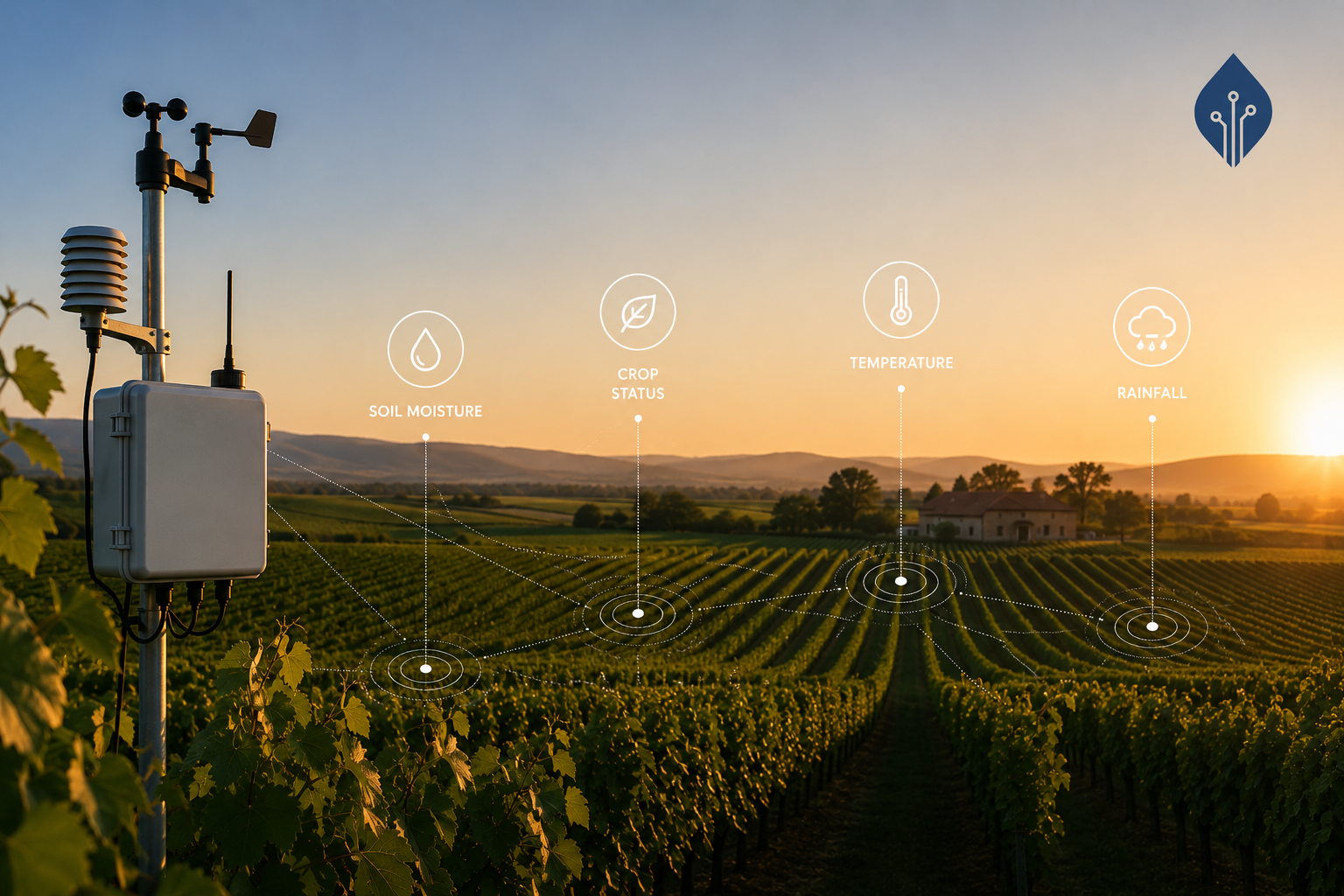
Depending on the application, crop monitoring may involve information related to: environmental and soil conditions, water availability, crop development, field activities, weather conditions, operational events.
Together, these observations create a more complete picture of what is happening in the field.
Why crop monitoring matters
Agricultural decisions are highly dependent on timing. An intervention that is appropriate today may be unnecessary several days later. Conditions can also vary considerably between different fields or production areas.
Reliable crop monitoring helps agricultural organizations reduce uncertainty by providing more consistent information about changing conditions. This can support decisions related to irrigation, field interventions, resource allocation, crop protection and harvesting activities.
The value does not come simply from having more measurements. It comes from understanding what those measurements mean within the operational context.
From periodic observations to continuous information
Field inspections provide valuable knowledge, but they represent specific moments in time. Conditions continue to change between one inspection and the next. Continuous monitoring helps fill these information gaps.
Environmental and field data can create a more detailed historical picture of how conditions evolve throughout the day, week or production cycle. This does not replace agronomic expertise. Instead, it provides additional information that can support it.
Crop monitoring and environmental conditions
Crop development is closely connected to the surrounding environment. Temperature, relative humidity, rainfall, soil moisture and other parameters can influence field conditions and agricultural activities.
For this reason, crop monitoring and environmental monitoring are closely connected. Local environmental information provides context for understanding what is happening directly within a production area.
When combined with field observations, this information can create a more complete understanding of crop conditions.
Connecting crop data with field operations
Crop information becomes more valuable when it is connected with operational activities. Consider irrigation. Knowing soil or environmental conditions is useful. Knowing those conditions together with when irrigation occurred provides additional context.
The same principle applies to harvesting, crop protection and other field activities. Connecting observations with operations makes it possible to move from isolated measurements toward Operational Visibility.
Crop monitoring is more than sensors
It is easy to associate digital crop monitoring with sensors alone. But sensors are only one part of a monitoring infrastructure.
A reliable system also requires: appropriate data collection, communication infrastructure, reliable data transmission and so many. The objective should never be to install technology simply because data can be collected.
Monitoring should begin with a question:
Which information can help us understand the operation better?
Supporting more efficient agricultural operations
Reliable crop monitoring can help organizations:
- understand changing field conditions;
- improve planning;
- identify relevant changes earlier;
- coordinate field activities;
- create historical operational records;
- improve resource management;
- support traceability.
The result is a stronger connection between what happens in the field and the decisions made around it.
Crop monitoring and digital agriculture
Digital agriculture is often described through technologies: sensors, IoT, remote sensing, platforms, connectivity. But technology alone does not make agriculture digital.
The real transition happens when information becomes integrated into everyday operational processes. Crop monitoring is one of the foundations of that transition because it creates a continuous information layer between physical field conditions and digital decision-support environments.
Looking ahead
Agricultural operations will continue to generate increasing amounts of information. The challenge will not be collecting everything that can be measured.
It will be identifying which information matters and connecting it with real agricultural activities. Future crop monitoring systems will therefore need to become increasingly integrated, reliable and operationally relevant. Because better monitoring is not ultimately about seeing more data. It is about understanding the field more clearly.
Conclusion
Crop monitoring creates a bridge between changing field conditions and agricultural decision-making. By combining environmental information, field observations and operational data, organizations can build a more complete understanding of what is happening throughout the production cycle. The objective is not to replace agricultural expertise.
It is to provide reliable information that helps expertise become even more effective.
Better decisions begin with a better understanding of the field.
FAQ
What is crop monitoring?
Crop monitoring is the systematic observation of crops and field conditions throughout the production cycle to create reliable information that supports agricultural management and decision-making.
Why is crop monitoring important?
Crop monitoring helps organizations understand changing conditions, improve planning, coordinate field activities and make more informed operational decisions.
What data can be used for crop monitoring?
Depending on the application, monitoring may include environmental conditions, soil parameters, water availability, crop observations and information about field activities.
Is crop monitoring the same as environmental monitoring?
No. Environmental monitoring focuses on environmental parameters, while crop monitoring considers the broader condition and development of crops. Environmental information can, however, provide an important component of crop monitoring.
Does crop monitoring replace field inspections?
No. Digital monitoring should complement agronomic expertise and direct field observations by providing continuous information between inspections.
How does crop monitoring support operational visibility?
By connecting crop and environmental information with field activities, organizations can understand not only individual measurements but also the operational context in which they occur.
Discover how Entity connects field monitoring, reliable data collection and operational visibility across agricultural environments.
No responses yet