


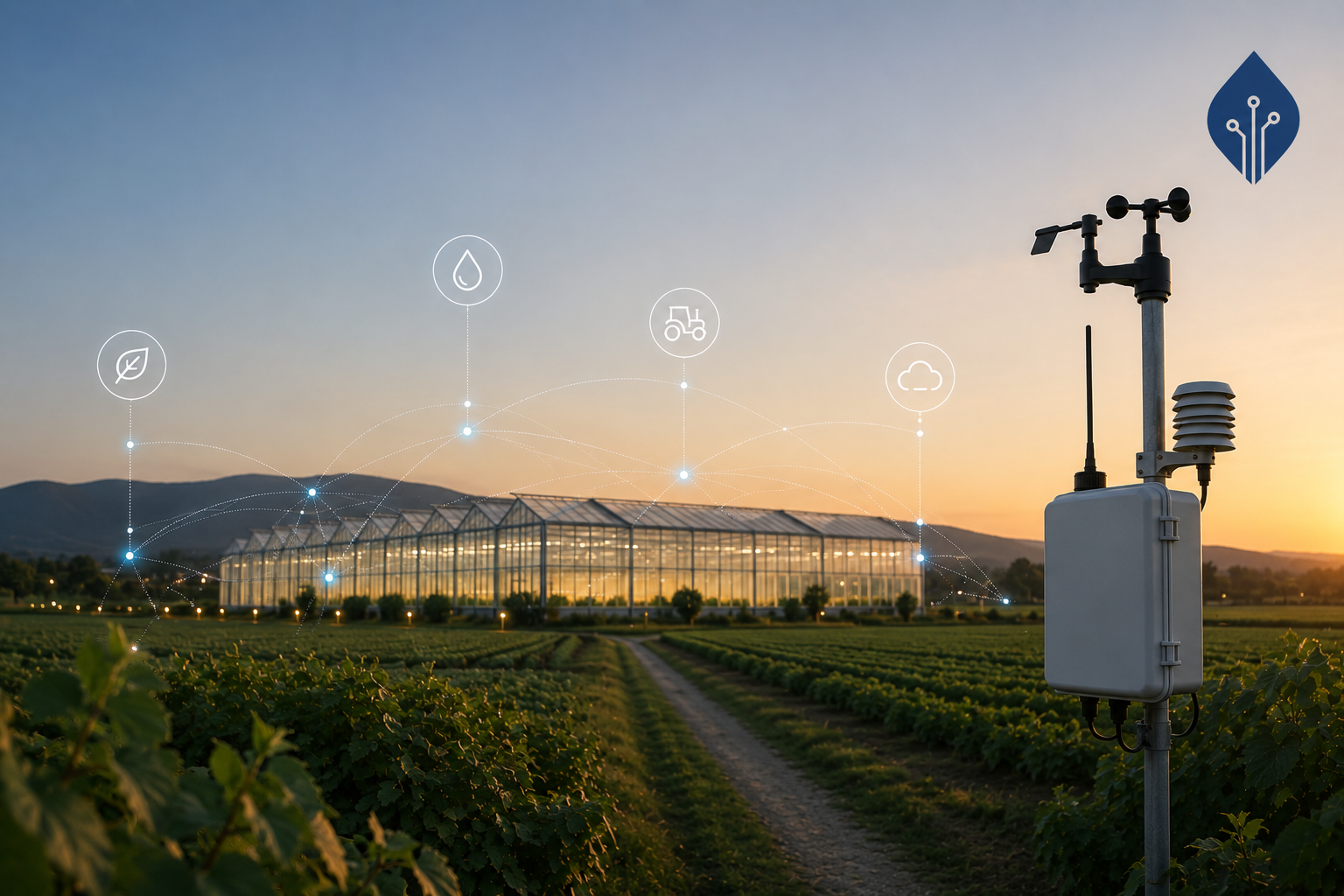
Agriculture is becoming increasingly connected. Monitoring devices collect environmental information. Equipment generates operational data. Field activities create digital records. Platforms make information accessible from different locations.
This growing connectivity is often described as the Internet of Things in Agriculture, or Agricultural IoT. But connecting devices is not the final objective.
A field can contain dozens of connected technologies and still provide limited operational understanding. The real value of IoT in agriculture emerges when connected technologies provide reliable information that helps organizations understand what is happening across their operations.
What Is IoT in agriculture?
IoT in Agriculture refers to the use of connected physical devices capable of collecting and exchanging information within agricultural environments.
These devices can collect information from fields, equipment, infrastructure and other operational environments and transmit it to digital systems where it can be stored, visualized or integrated with other data.
An agricultural IoT infrastructure may include: field monitoring devices, environmental sensors, connected equipment and much more. The technology creates the connection.
What matters is what organizations can do with the information generated by that connection.
From connected devices to connected operations
One of the most common misconceptions about Agricultural IoT is that connectivity automatically creates value. It does not. Connecting a sensor creates a data stream. Connecting that information with an operational process creates context. Consider environmental monitoring.
A temperature measurement provides information. But when that measurement can be connected with a specific field, crop, operational event or period of activity, it becomes considerably more useful.
This is the difference between connected devices and connected operations.
How IoT supports agricultural monitoring
Agricultural environments are distributed by nature. Fields may cover large areas. Operations take place outdoors. Infrastructure can be located far from offices or technical teams. IoT technologies allow information to be collected directly where operations take place and transmitted remotely. This can support continuous monitoring of conditions without requiring every observation to be performed manually. It can also create historical datasets that help organizations understand how conditions and activities evolve over time.
Field data collection
Reliable field data collection is one of the fundamental functions of Agricultural IoT. Information can be generated continuously rather than only during periodic inspections. However, the quality of the resulting system depends on more than collection frequency.
Field technologies must operate under real environmental conditions. Connectivity must be reliable. Devices must generate consistent information. And the resulting data must remain accessible to the people who need it.
This is why designing an Agricultural IoT infrastructure requires an operational perspective, not simply a technological one.
The importance of connectivity
Agricultural IoT systems depend on communication between devices and digital infrastructure. But agricultural environments create specific connectivity challenges: distance, physical obstacles, outdoor conditions, power availability, network coverage
Different applications may therefore require different communication technologies and architectures. There is no single connectivity model suitable for every agricultural environment.
The infrastructure should be designed around the characteristics of the operation.
IoT and operational visibility
The greatest potential of IoT does not come from observing individual devices. It comes from connecting different sources of operational information: environmental conditions, field activities, equipment, harvesting and more.
When information from these activities becomes accessible within a connected environment, organizations can begin to develop a broader understanding of operations. This is Operational Visibility. IoT provides part of the infrastructure.
Operational Visibility is the outcome organizations actually need.
IoT is an infrastructure, not a strategy
Installing connected devices does not automatically create Digital Agriculture. Technology must support a clear operational objective.
Before implementing an IoT monitoring infrastructure, organizations should therefore ask:
- What do we need to understand?
- Which operational decisions require better information?
- Where are the current information gaps?
- Which data should be collected?
- How frequently is it needed?
- Who needs access to it?
- How will the information be used?
These questions should determine the technology — not the other way around.
IoT, Smart farming and Digital agriculture
IoT, Smart Farming and Digital Agriculture are often used interchangeably. They describe related but different concepts.
IoT provides connectivity between physical devices and digital environments.
Smart Farming applies digital technologies and information to agricultural management.
Digital Agriculture describes the broader integration of digital information into agricultural processes.
IoT is therefore an enabling infrastructure. Its value depends on how effectively it supports agricultural operations.
Looking ahead
The number of connected technologies used in agriculture will continue to increase. But more devices will also generate more information. This makes integration increasingly important. The future challenge will not simply be connecting everything that can be connected.
It will be creating monitoring infrastructures capable of turning distributed field information into reliable operational knowledge. Agricultural IoT will create its greatest value when the technology becomes almost invisible and the information becomes immediately useful.
Conclusion
IoT is changing how agricultural information can be collected, transmitted and accessed. But connectivity alone does not improve agricultural operations. Value emerges when connected technologies provide reliable information that can be understood within the context of real field activities. For agriculture, the objective should therefore not be to create more connected devices.
It should be to create better connected operations.
FAQ
What is IoT in agriculture?
IoT in agriculture is the use of connected physical devices and communication infrastructure to collect and exchange information from agricultural environments.
How is IoT used in agriculture?
IoT can support environmental monitoring, field data collection, equipment monitoring, geolocation, remote monitoring, traceability and other agricultural operations.
What are the benefits of Agricultural IoT?
Agricultural IoT can improve access to field information, support continuous monitoring, create historical records and contribute to better operational visibility.
Is IoT the same as Smart Farming?
No. IoT provides connectivity and data collection infrastructure, while Smart Farming is a broader approach that uses digital technologies and information to support agricultural management.
What are the challenges of IoT in agriculture?
Challenges can include connectivity, device reliability, environmental conditions, power availability, system integration and transforming collected data into useful operational information.
Why is field data reliability important for Agricultural IoT?
Connected systems depend on the quality of the information they collect. Unreliable field data can reduce the usefulness of the entire monitoring infrastructure.
Discover how Entity develops connected monitoring infrastructures designed around real agricultural operations.
No responses yet