


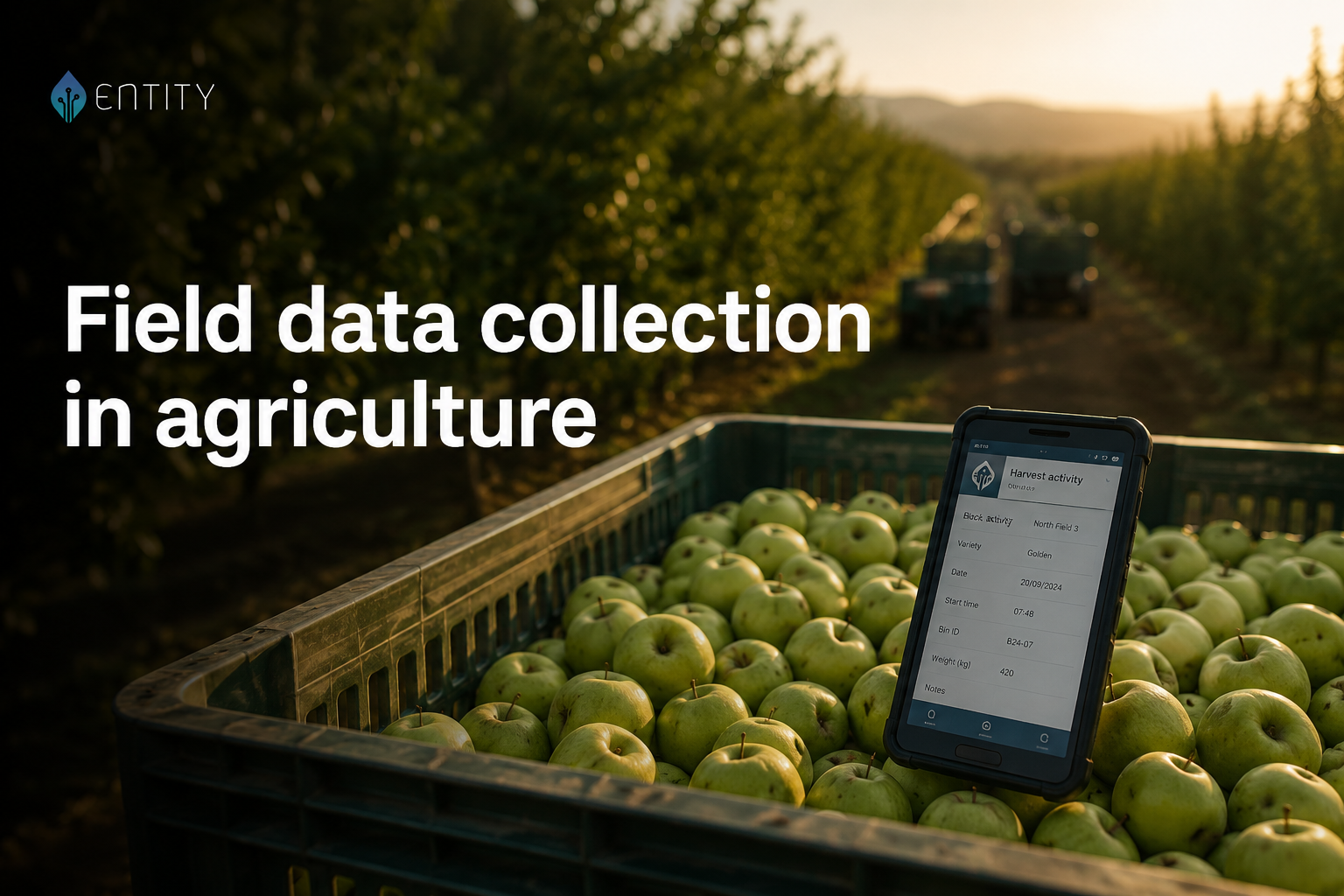
Agricultural operations generate information continuously.
A crop is inspected, a harvesting activity begins, a container is filled. Environmental conditions change: a vehicle leaves the field. A load reaches its destination. Each of these moments can generate useful information about what is happening across an agricultural operation.
The challenge is that much of this information does not automatically become data! Some of it is recorded manually. Some remains fragmented across different systems. Some is reconstructed later. And some is never captured at all!
This is why field data collection is becoming an important part of digital agriculture: the objective is not simply to collect more data, it is to create a reliable connection between what happens physically in the field and the information available to the people and systems managing the operation.
What is field data collection?
Field data collection is the process of capturing information directly from agricultural environments and operations. Depending on the application, this can include:
- environmental conditions
- soil parameters
- crop observations
- location data and other
The information may come from sensors, connected devices, machinery, geolocation systems, digital applications or existing operational systems. But the technology used to capture the data is only one part of the process. For field data to be useful, it must also have context.
A temperature value, for example, tells us something about an environment; A temperature value connected to a specific location, time, crop, production lot or operational event tells us considerably more. That distinction is fundamental.
The gap between physical operations and digital information
Many agricultural businesses already use digital systems. Management platforms, ERP systems, databases and dashboards can organize large amounts of information.
But there is a question that comes before all of them: how does information about a physical operation enter the digital system in the first place?
This is one of the most important challenges in field digitalization. An operation may take only a few seconds in the real world: a container is moved, a harvesting activity begins. If that event is not captured when it happens, someone may need to record or reconstruct it later. This creates a gap between physical operations and their digital representation.
Reducing that gap is one of the main purposes of effective field data collection.
Why manual data collection has limits
Manual data entry remains useful in many agricultural processes. Not every activity needs to be automated, and not every piece of information requires continuous monitoring. However, relying heavily on manual collection can introduce operational limitations.
Information may be entered at different times. Records may follow different formats. Some activities may be documented only after they have occurred.
Operators may need to interrupt their normal workflow to enter information. When something is missing, teams may need to reconstruct events through spreadsheets, phone calls, paper records or other sources.
The problem is therefore not simply whether data exists. The question is: how much work is required to create, verify and understand it? A well-designed field data collection system should reduce unnecessary friction rather than introduce another task into an already complex operation.
Field data needs operational context
Consider a simple location coordinate. On its own, it tells us where something was at a specific moment. Connect that coordinate to a harvesting event, a production lot, a container and a timestamp, and the information begins to describe an operation.
The same applies to environmental information: temperature and humidity values can be useful individually, but their operational value increases when they can be associated with a specific crop, location, period or activity.
This is where field data moves beyond isolated measurements. It becomes structured operational information.
The objective is not to create the largest possible dataset, it is to preserve the relationships between events, conditions, locations and activities.
From field data collection to traceability
Field data collection also plays an important role in agricultural traceability. Traceability is often associated with the final stages of the supply chain, where information about a product is already available in business systems.
But the history of that product starts much earlier. It starts with physical events: harvesting. handling. movement. transport., storage. Each event can contribute to the digital history of a product or production lot.
When information is captured close to the moment in which these activities happen, traceability can become more continuous and less dependent on retrospective reconstruction. Instead of asking later: what happened to this product? the system can progressively build that history as operations take place.
The importance of reliable data
Collecting information automatically does not guarantee that the information is useful. Field environments create specific technical challenges. Connectivity can be inconsistent, devices operate outdoors, environmental conditions can change rapidly, equipment and operators are constantly moving.
A monitoring infrastructure must therefore consider not only what information should be collected, but also how reliably it can be captured and transferred.
This means evaluating aspects such as:
- data accuracy
- connectivity
- power consumption
- device reliability and more
A field data collection architecture must be designed around the environment in which it operates. Technology that works perfectly in controlled conditions may behave very differently when deployed across real agricultural operations.
Not every data point needs to be real-time
Digital agriculture is often associated with real-time information. But real-time data should not automatically be considered the objective for every application. Some information requires immediate visibility.
Other information may only need to be collected periodically or made available at a later stage. The relevant question is not:
Can we collect this in real time? It is: When does this information need to become available to create operational value?
This distinction affects connectivity requirements, system architecture, energy consumption and implementation costs. Effective monitoring infrastructure should therefore reflect the actual needs of the operation rather than pursue connectivity for its own sake.
Designing data collection around the operation
One of the most important principles in field digitalization is simple: technology should adapt to the operation, not force the operation to adapt to the technology. Agricultural environments already have established workflows. People move, equipment moves, products move.
Activities can change depending on weather, crop conditions, logistics and production requirements. Adding a digital system that requires excessive manual interaction can create new complexity instead of reducing it. This is why designing field data collection should begin with understanding the operation itself.
What happens? Who is involved? Where does it happen? Which information already exists?
Only after answering these questions does the choice of devices, sensors, networks and software become meaningful.
From data collection to operational visibility
Collecting field data is not the final objective. Information becomes valuable when it helps create a clearer picture of what is happening across operations. This can mean understanding environmental conditions across different areas: knowing when harvesting activities occurred, following the movement of products or containers, connecting field events with logistics.
This progression can be understood as: physical operation → data capture → context → structured information → operational visibility
Each step matters. If the initial information is incomplete or disconnected from its context, the systems that depend on it will inherit the same limitations.
Building better digital agriculture from the field
Digital agriculture does not begin with a dashboard. It begins with understanding what happens before information reaches that dashboard.
Fields, operators, products, equipment and environmental conditions continuously generate events that can help organizations understand their operations. The challenge is deciding which of those events matter and creating reliable ways to capture them.
For this reason, field data collection should not be treated simply as a technical exercise. It is part of the infrastructure connecting physical agricultural operations with digital systems. The quality of that connection determines the quality of the information available further along the process.
Better digital operations begin with reliable information from the field!
No responses yet