


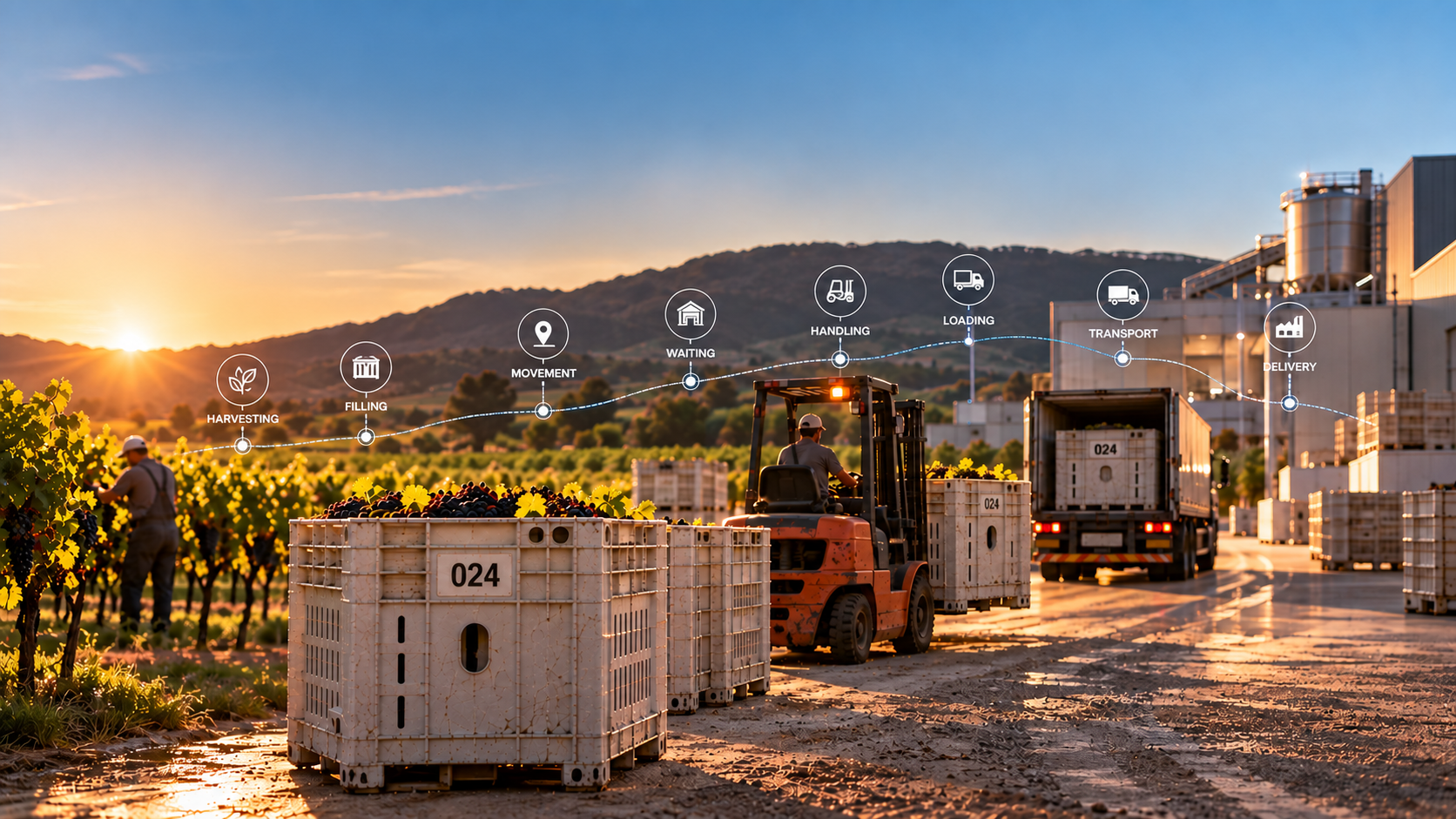
Agricultural operations are constantly moving. Products are harvested, containers are filled, loads are moved across the field.
Every one of these activities generates information. Yet what happens physically and what becomes visible digitally are not always the same thing. A company may know where a product was harvested and where it was delivered while still having limited visibility into everything that happened in between.
This is where operational visibility in agriculture becomes important. Operational visibility is not simply about collecting more data. It is about creating a reliable digital representation of real agricultural operations — connecting events, locations, assets and time so that businesses can understand how an operation actually unfolded.
What is operational visibility in agriculture?
Operational visibility is the ability to understand what is happening, or what has happened, across the different stages of an agricultural operation. Consider a container used during harvesting.
During a single day, that container may be:
- filled in the field;
- moved to a collection point;
- temporarily stored and muche more!
Physically, these events are straightforward. Digitally, however, they may be much harder to follow. If information is entered manually, stored across different systems or recorded only at specific checkpoints, the digital representation of the operation can become fragmented.
Operational visibility aims to reduce this gap: it connects physical events with digital information so that the history of an operation does not have to be reconstructed only after it has happened.
The gap between physical operations and digital systems
Agriculture presents a particular challenge for digitalization because operations do not happen inside a controlled digital environment. They happen in fields, loading areas, warehouses, processing facilities and on the road.
And the operation does not wait for the information system. A container can be filled whether the event is recorded or not. A forklift can move it whether its new position enters a database or not. This creates a fundamental question:if it happened, was it recorded?
An event occurring physically does not automatically mean that the same event exists digitally! When that connection is missing, people often become responsible for closing the gap later through spreadsheets, phone calls, paper records or information coming from multiple systems. The challenge is therefore not only to digitalize the final result of an operation, it is to make relevant operational events digitally visible as they occur!
From A to B is only part of the story
Many supply-chain records are naturally built around checkpoints. A product starts at point A and arrives at point B. Both pieces of information are useful, but a significant part of the operational history may exist between them.
Between a field and a processing facility, for example, a product may be harvested, placed into a container, moved several times, wait in a collection area, be loaded onto a truck and travel to its destination. The final delivery record confirms that the journey was completed.
It does not necessarily explain how that journey happened.This distinction matters because agricultural traceability is not only about identifying an origin and a destination. It can also depend on understanding the sequence of events connecting them. Operational visibility makes this intermediate layer easier to see.
The events that build an operational history
Agricultural operations are made up of relatively simple events: a container is filled, it moves, it reaches a loading area, it is loaded, it leaves.
Individually, none of these events is particularly complex. The challenge appears when they are repeated across dozens or hundreds of containers, different fields, vehicles, operators and destinations. At that scale, reconstructing the operation becomes more difficult! Creating an operational history therefore means connecting relevant events with their context.
Depending on the process, this may include: time — When did the event occur? Location — Where did it happen? Asset — Which container, vehicle or operational unit was involved? Event — What actually happened? Sequence — What happened before and what happened next?
Together, these elements transform isolated observations into a structured representation of the operation.
A GPS point is not a story
Geolocation is a useful example of the difference between having data and having operational context. A GPS coordinate can tell us where an asset was at a particular moment. But location alone may not tell us why it was there or what was happening.
Was the container being filled? Was it waiting? Was it being transported? Had it reached its destination?
A location becomes more meaningful when it can be connected to an operational event! The same principle applies to timestamps, identification codes and other individual data points. Data needs context.
When location, time, asset identification and events can be connected, businesses gain something more useful than a collection of coordinates or records: they begin to see the history of the operation.
Operational visibility and traceability
Operational visibility and agricultural traceability are closely connected, but they are not exactly the same concept. Traceability focuses on the ability to follow or reconstruct the history of a product, lot or asset across a process or supply chain.
Operational visibility focuses on understanding the activities that generate that history. The distinction becomes clearer when we look at a harvesting operation. Traceability may need to answer questions such as:
Where did this product come from? Which lot does it belong to? Where was it delivered?
Operational visibility can add another layer: When was the container filled? When did it leave the field?
How did it move through the operation? Which events occurred before delivery?
In practice, better visibility into operations can create a stronger foundation for traceability because relevant information is captured closer to the moment in which it is generated.
Technology should follow the operation
Improving operational visibility does not mean adding technology everywhere. The objective should not be to make agricultural operations more complicated in order to collect more information. People in the field already have work to do.
If digitalization introduces another form to complete, another screen to check or another manual step to remember, data collection itself can become an additional operational burden. Technology should therefore adapt to the process rather than forcing the process to adapt to the technology. This is where technologies such as IoT, geolocation and automated data collection can play an important role.
When appropriately integrated into an operation, they can help capture relevant events and connect them with time, location and asset information while reducing dependence on manual reconstruction.
The technology is not the final objective. Understanding the operation is.
Connecting field operations with bsiness systems
Collecting information from the field is only one part of the challenge. That information also needs somewhere to go. Agricultural and agri-food businesses may already use ERP platforms, logistics systems, traceability tools, databases and reporting environments. Creating another isolated data source does not necessarily improve visibility. The more useful approach is to connect the operational layer with the digital systems already used by the organization.
The flow can be understood simply:physical operation → data capture → operational context → structured information → business systems
Through dashboards, APIs and system integrations, information generated during physical operations can become available to the wider digital infrastructure of the company. This allows field data to become part of existing workflows rather than remaining separated from them.
Operational visibility at scale
Following one container is relatively easy. Following hundreds of containers moving through multiple operations at the same time is different. This is where operational visibility becomes particularly relevant. As the scale of an operation increases, so does the number of events that need to be connected. Containers are filled at different times. Assets change location. Vehicles arrive and leave. Products move towards different destinations. The individual activities remain simple. The overall operation becomes complex.
Digital systems can help preserve the relationship between those events, making it easier to understand what happened without relying exclusively on manual reconstruction. This is not about collecting every possible piece of information. It is about identifying the events that matter and making them reliably visible.
From field to facility
Digital agriculture is often represented through dashboards, maps and analytics. But operational visibility begins much earlier.
It begins with a physical event. A harvest, a filled container, a movement, a loading operation, a delivery.
The more effectively these events can be connected to their digital representation, the smaller the distance becomes between what is happening in the real operation and what the organization can actually see. And that creates a stronger foundation for monitoring, traceability and integration across the agri-food supply chain. Operational visibility begins when the digital record can keep pace with the physical operation.
Entity: connecting physical operations with digital systems
Entity develops IoT and software technologies designed around real agricultural and agri-food operations.
From field activities and data collection to harvest tracking, geolocation and traceability, our approach focuses on connecting physical events with structured digital information that can integrate with existing business systems.
Technology starts with the operation.
No responses yet