


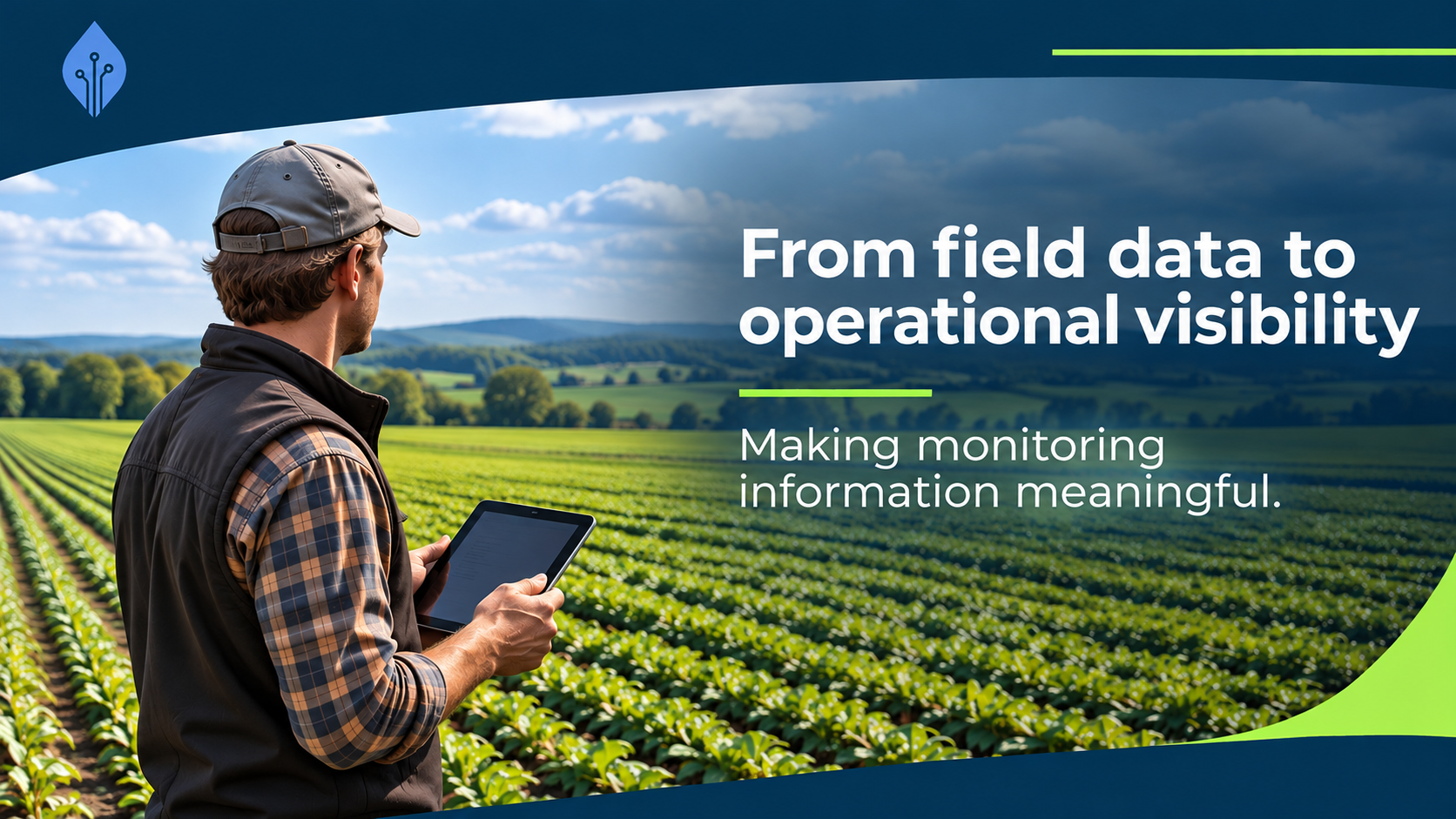
Collecting data is only the beginning. In agricultural and industrial environments, the real challenge is making information reliable, accessible and connected to the operations it represents.
A soil moisture reading, a temperature measurement or a location update: each of these can provide valuable information about what is happening in the field.
But collecting a measurement doesn’t automatically mean understanding an operation. Consider a simple example: a sensor records a change in soil moisture during the morning. The measurement is available, but several questions remain.
Where exactly was it collected? When was the last successful transmission? Is the reading consistent with previous measurements? What other conditions might explain the change? And, most importantly, how can that information support the people managing the operation?
These questions highlight a fundamental distinction in agricultural monitoring: the difference between collecting data and making it operationally useful.
1. Reliable information starts with real operating conditions
Agricultural environments are not controlled laboratories. Devices may operate across large areas, exposed to changing temperatures, humidity, dust, rainfall and other environmental conditions.
These factors can influence how monitoring technologies perform over time. A device that works correctly during initial testing may encounter very different challenges once installed in the field.
For this reason, monitoring infrastructure needs to be considered as a complete operational system, rather than a collection of individual sensors. Hardware design, firmware behaviour, installation conditions, maintenance requirements and data quality all contribute to the reliability of the information collected.
Testing is therefore not simply a final step before deployment. It is part of understanding how technology behaves under the conditions in which it is expected to operate. A successful prototype demonstrates that a concept can work.
The next challenge is understanding how consistently it can perform in practice.
2. Collecting data and transmitting data are different challenges
In many agricultural areas, connectivity cannot be taken for granted. Fields may be located far from buildings, communication infrastructure or reliable network coverage.
Even when a device successfully records a measurement, transmitting that information to a central platform can present additional difficulties.
This creates an important distinction between two aspects of monitoring:
- Data acquisition: collecting measurements from the environment or an operational process.
- Data availability: making those measurements accessible to the systems and people who need them.
A monitoring architecture must consider both. Depending on the application, this may involve evaluating communication technologies, transmission intervals, power consumption and how the system handles temporary connectivity interruptions.
For example, a system designed to store measurements locally during an interruption and transmit them later may be appropriate for some monitoring applications. Other applications may require more immediate information and different communication strategies.
There is no single approach that fits every environment. The appropriate design depends on what needs to be monitored, where the infrastructure operates and how the information will be used.
Connectivity is not an additional feature. It is part of the operational design.
3. A measurement needs context
Imagine receiving a temperature reading of 28°C. By itself, the number provides limited operational insight. Its meaning changes depending on where it was measured, when it was recorded and which activity or process it relates to.
The same principle applies to soil moisture, environmental conditions, equipment status and logistics information.A useful monitoring record may need to answer several questions: What was measured? Where did the measurement originate? When was it recorded? Was the information received correctly? Which field, asset or operation does it relate to?
Without this context, even technically accurate measurements can be difficult to interpret!
Consider soil moisture monitoring: a measurement can contribute to understanding water availability in the ground, but irrigation decisions may also depend on soil characteristics, crop requirements, growth stage and expected weather conditions.
The value of monitoring is not that a single number provides every answer. It is that reliable measurements can contribute to a more complete understanding of field conditions.
This is where structured information becomes important. Timestamps, locations, device identifiers and operational references help turn isolated measurements into records that can be compared, interpreted and used.
4. Operational visibility requires connected information
Many agricultural and industrial organisations already use multiple digital tools. Environmental monitoring platforms, production systems, logistics applications and business management software may all contain relevant information.
However, these systems do not necessarily communicate with one another. The result can be fragmented operational visibility.
A measurement may be available in one platform, while the information needed to interpret it is stored elsewhere. For example, environmental data might become more useful when it can be associated with a specific field or production activity.
Similarly, a logistics record becomes more informative when it can be connected to the relevant operational event.
This does not mean that every organisation needs to replace its existing software.
In many cases, the challenge is understanding how information can move between systems while preserving its meaning and reliability.
Integration is therefore not simply a technical connection between databases or applications.
It also requires attention to how information is identified, organised and used within operational workflows.
The objective is not to create more dashboards. It is to make relevant information easier to access and understand.
5. From monitoring to traceability
Monitoring and traceability address different questions, but they share an important requirement: reliable information connected to real events. Monitoring helps describe conditions or changes over time. Traceability helps establish the relationship between products, assets, locations and operational activities.
In agricultural supply chains, this distinction becomes particularly relevant: knowing that a measurement was recorded is useful. knowing which operation, location or stage of a process it relates to can provide a more complete picture.
A structured approach to operational information can support consistency across different stages, from activities in the field to subsequent logistics and processing operations. However, effective traceability depends on more than collecting large volumes of data.
It requires appropriate identifiers, consistent records and clearly defined relationships between events. Information must remain understandable as it moves from one part of an operation to another.
This is why monitoring infrastructure, software integration and traceability should not always be considered as separate technological challenges. They are different components of a broader need: maintaining visibility across operational processes.
6. Start with the operation, not the technology
When evaluating a monitoring project, the first question is often technical.
Which sensor should be installed? Which communication protocol should be used? Which platform should display the measurements?
These questions matter, but they should follow a more fundamental discussion: what operational problem needs to be understood?Who needs the information? How frequently is it required? What happens when a measurement is missing or delayed? How will the information influence the way an activity is managed?
The answers help determine which technologies are appropriate and how they should work together. A system designed around actual operational requirements is easier to evaluate than one defined primarily by the number of devices installed or measurements collected.
This approach is particularly important in agricultural environments, where conditions can vary significantly between locations, seasons and activities. Technology must respond to those differences rather than assume that every operation follows the same pattern.
Making field information meaningful
The development of monitoring and traceability technologies continues to create new opportunities for agricultural and industrial operations, but their practical value depends on several connected factors.
Measurements need to be reliable. Communication infrastructure needs to reflect real operating conditions. Information needs context. And the resulting data needs to be accessible within the processes where it can be useful.
At Entity, we develop monitoring and traceability technologies for agricultural and industrial environments, focusing on the relationship between field information and operational requirements.
Our perspective starts with a practical consideration: collecting data is an important step, but it is not the final objective.
The objective is to make information meaningful, accessible and connected to the operations it represents.
No responses yet